UTC Offset or Time Zone? Store the Information Your Schedule Needs
UTC+02:00 describes a difference from UTC at an instant. Europe/Paris identifies a set of location-based clock rules. They can agree on one date and give different scheduling behavior on another. Choose the representation that matches the task.
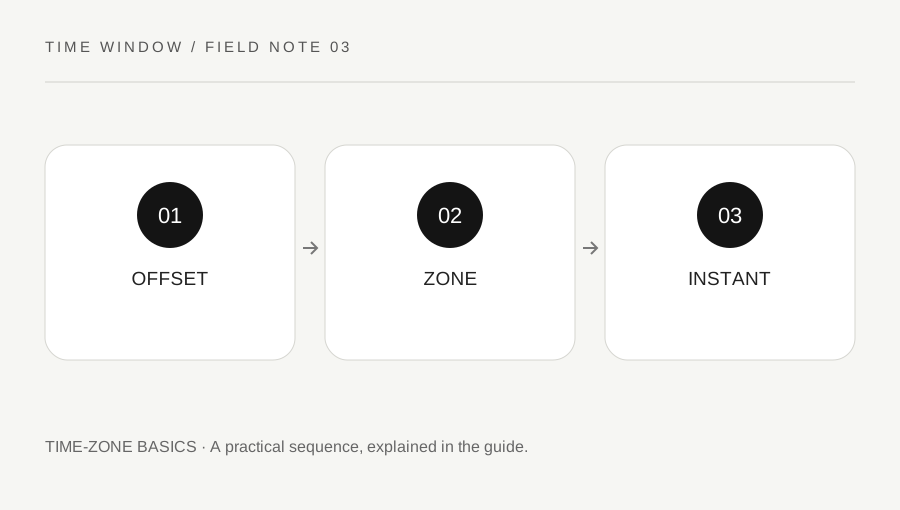
Original explanatory diagram. Numerical examples in this guide illustrate the reasoning; they are not a claim of hands-on testing.
Start with a single instant
An instant can be represented in UTC and displayed in many local zones. If one display reads 12:00 at UTC+02:00, the corresponding UTC reading is 10:00. Changing the display zone changes the label, not the underlying instant. This is why participants can join one meeting even though their clocks show different hours.
A numeric offset is sufficient to disambiguate a properly formed timestamp for a recorded event. It does not, by itself, say which jurisdiction supplied that offset or how the local clock will behave next month. Preserve the named zone as additional information when the local scheduling context matters.
Recognize what a named zone contains
An IANA identifier such as America/Chicago or Europe/Paris refers to a location-based collection of time-zone rules. It is not simply a longer spelling of a fixed offset. The rules can include seasonal transitions and historical changes. Identifiers use representative locations; the spelling is part of the identifier, not a promise that every surrounding region always shares its rules.
Our converter accepts IANA names that your browser supports. Use the destination's actual zone rather than choosing a city with today's matching clock. A matching offset today does not establish matching rules for a later event. Check spelling if an identifier is rejected; do not replace an unknown zone with a guessed abbreviation.
Compare a seasonal scheduling example
Suppose you intend a call at 09:00 in Europe/London every Monday. Keeping that local appointment means its UTC hour can change when London's local rules change. Storing a fixed UTC hour would instead keep the same global instant pattern while potentially changing the London clock reading.
Neither design is inherently wrong. A local shop opening time usually follows local civil time, while a system maintenance process might intentionally use a fixed UTC schedule. Write the requirement in words before selecting the data representation. “Always 09:00 in London” and “always the same UTC hour” are different instructions that may only coincide for part of the year.
Avoid ambiguous abbreviations
Short labels such as CST can refer to more than one region, while a seasonal label copied from an old invitation can become inaccurate. Prefer the full named zone plus a specific date. If you also include an offset, derive it for that occurrence rather than assuming it is permanently attached to the location.
Use a twenty-four-hour clock or clearly state AM and PM. Midnight should carry an explicit date: the start of Tuesday is different from the end of Tuesday. When an event crosses the international date line, show the destination date as well as its time. A bare “8 PM there” leaves too many assumptions for an international participant.
Keep a useful event record
For a one-off event, record the confirmed instant and the organizer's zone. For a recurring series, record the local recurrence rule, named zone and the policy for skipped or repeated local times. Many calendar applications make these choices visible through their scheduling interface; review the resulting occurrences around seasonal changes.
Our tool converts a single local reading, not an entire recurrence series. It displays ambiguity rather than inventing a policy. Browser data can lag newly announced rule changes, so update devices and consult the relevant authority when necessary. A precise-looking timestamp is valuable only when its date, zone and scheduling intention have been understood correctly.
A practical checklist
Tick items for your own use. This checklist is saved only in this browser.
Questions that come up
Is UTC the same as my local time zone?
UTC is a global reference time scale. Your local civil clock may currently share its offset, but a location-based zone can have its own seasonal or historical rules. Matching today does not make the concepts interchangeable.
Can I choose any city with the same time today?
Use the actual location’s zone. Two places can share an offset now and diverge later because their transition rules differ. A remembered present-day difference is unreliable for future scheduling.
What does the converter save?
The calculator works locally and does not save your entries as an event. Copy the confirmed result into your own calendar, including the relevant zone and any resolved repeated-hour choice.
References & scope
Background references checked on 18 October 2026. The examples and practice exercises are original editorial explanations, not copied procedures or professional advice.