Daylight Saving: Why a Local Time Can Be Missing or Repeated
A clock reading is not always enough to identify one instant. When local clocks move forward, some readings do not occur. When clocks move backward, some occur twice. A careful converter exposes that ambiguity instead of silently choosing for you.
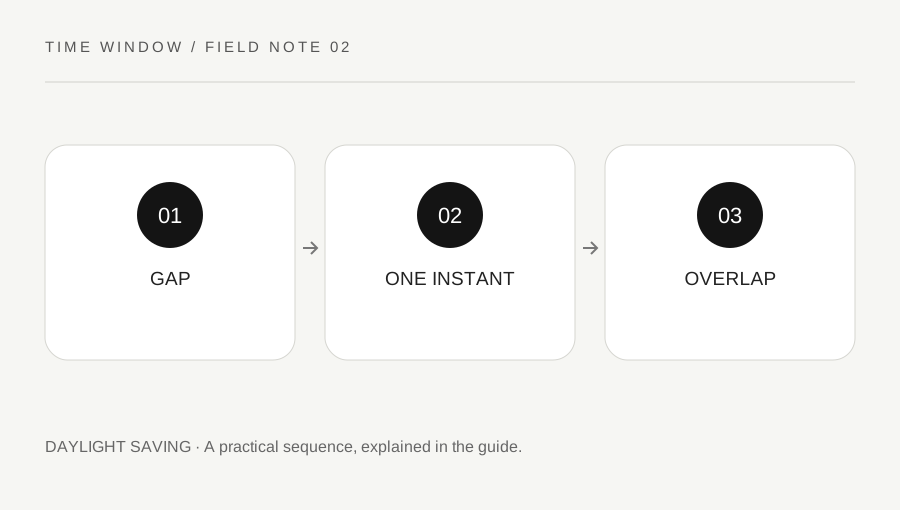
Original explanatory diagram. Numerical examples in this guide illustrate the reasoning; they are not a claim of hands-on testing.
Picture the forward jump
Imagine a jurisdiction where the clock advances from 01:59 to 03:00. The wall-clock readings between 02:00 and 02:59 are skipped that day. A request for 02:30 in that location has no matching instant under those rules. It is not an unusual way to write 03:30; it is an invalid local appointment until someone chooses a replacement time.
The exact transition date, clock hour and size of the change depend on the jurisdiction. Do not assume every place changes by one hour or follows the same seasonal schedule. Our converter checks the supplied date and IANA zone against the browser's available rules and reports when it cannot find a matching instant.
Picture the backward repetition
Now imagine a clock moving from 01:59 back to 01:00. The reading 01:30 occurs once before the change and again after it. Each occurrence has a different UTC offset and corresponds to a different instant. Writing only the local date and 01:30 leaves the appointment incomplete.
The converter displays both matching UTC instants and their destination-zone readings. It does not label one as the correct appointment without your decision. Ask the organizer which occurrence is intended, or move the event outside the repeated hour. The terms earlier occurrence and later occurrence are often clearer than assuming everyone understands a seasonal abbreviation.
Check a concrete modern example
Under the familiar recent rules for America/New_York, the local time 2026-11-01 at 01:30 has two occurrences. They correspond to 05:30 UTC and 06:30 UTC. A converter that simply produces one of these without explanation has hidden a meaningful choice. These example rules should still be checked against updated local information if legislation changes.
For a forward-gap test, Europe/London at 2026-03-29 01:30 has no local occurrence under the corresponding rules. The correct response is to request a different intended time. These are useful validation examples for the tool; they are not a worldwide timetable of daylight-saving transitions.
Keep the invitation precise
Once an instant is chosen, include the full local date, local clock time, named zone and an offset or UTC reference. Calendar software can then show the appropriate reading for each participant. For a repeated hour, explicitly say which occurrence was chosen. An informal message saying “same time as usual” is insufficient near a change.
Recheck recurring appointments when participants live in places with different transition schedules. One organizer may keep a fixed local time while another sees a temporary shift. A fixed offset copied from last month's invitation does not automatically preserve the intended local time. Review the actual date rather than reusing a remembered difference.
Understand the tool’s limits
Our converter uses the time-zone database bundled with your browser or operating system. IANA publishes updates as governments change rules, but those updates take time to reach devices. If a jurisdiction has recently announced a change, compare the result with its current official guidance and your updated calendar software.
The tool supports local conversion years from 2000 through 2099, to keep its practical scope explicit. A future result follows current installed rules and cannot predict future legislation. For travel connections, examinations, broadcasts or other consequential events, the organizer's confirmed schedule remains essential even when the arithmetic is internally consistent.
A practical checklist
Tick items for your own use. This checklist is saved only in this browser.
Questions that come up
Why does a missing time return an error?
There is no instant with that local date and clock reading under the available rules. Choosing the next valid hour automatically could change the organizer’s intention, so this tool asks you to choose another time.
Which repeated occurrence should I select?
Ask the event organizer. Both are valid instants, so the date and clock reading alone cannot decide. The displayed UTC references help distinguish them precisely.
Does every place use daylight saving?
No. Rules vary by location and date, and governments can change them. Use a location-based IANA zone and updated data instead of assuming a country or continent shares one rule.
References & scope
Background references checked on 18 October 2026. The examples and practice exercises are original editorial explanations, not copied procedures or professional advice.