Leap Years, Calendar Days and 24 Hours: Three Different Questions
A leap year changes the number of dates in February. A local clock change can alter the elapsed hours between two local midnights. Neither fact changes the need to specify what you are counting: dates, duration or calendar anniversaries.
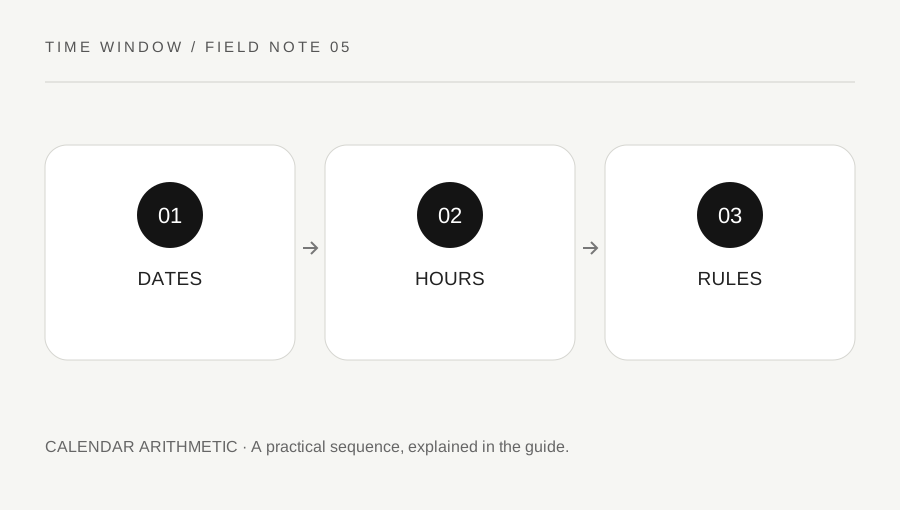
Original explanatory diagram. Numerical examples in this guide illustrate the reasoning; they are not a claim of hands-on testing.
Apply the Gregorian leap-year test
For the Gregorian calendar, a year divisible by four is normally a leap year. Century years are exceptions unless divisible by four hundred. Thus 2000 was a leap year, while 2100 will not be. The extra date is February twenty-ninth; other month lengths do not gain an extra day.
This rule is a calendar calculation, not a prediction about a local time-zone offset. Our date interval tool uses the Gregorian calendar for years 1900 through 2100 and validates the requested day before calculating. A February twenty-ninth entry in a non-leap year should be rejected, not silently normalized into March.
Distinguish dates from elapsed duration
Calendar dates answer questions such as how many date labels fall between two given dates. Elapsed duration answers how much time passes between two specific instants. To calculate duration accurately, you need clock times and zones or timestamps, not merely two dates written on paper.
Around a local daylight-saving transition, one local midnight to the next may span twenty-three or twenty-five hours under common one-hour-change rules. Nevertheless, the date advances once. Treating every local date step as exactly twenty-four elapsed hours can therefore produce misleading results. The right method depends on whether the task concerns a date range or a timed interval.
Check February with a worked range
For February 28 to March 1 in 2024, the elapsed calendar-day difference is two because February twenty-ninth lies between the endpoints. In 2025 the same month-and-day range has an elapsed difference of one. Inclusive counting adds one endpoint date to each ordered range, producing three and two respectively.
These results do not determine an annual subscription's billing policy or a person's anniversary convention. An organization may define what happens to a February twenty-ninth anniversary in non-leap years. Read that policy instead of substituting an arithmetic assumption. A calculation can show the dates available without deciding which date a contract or service recognizes.
Avoid average-month arithmetic
Dividing a day count by thirty does not produce an exact calendar-month count. Months have different lengths, and adding one month to a late-month date requires an explicit rollover policy. Similarly, dividing a day count by 365 can describe an approximate duration in average-style years but does not reproduce calendar birthdays or anniversary dates.
Use the simplest quantity that matches the question. If you need the number of calendar days, keep it in days or complete seven-day weeks plus a remainder. If you need calendar months, use a tool and policy designed for month arithmetic. Do not label a decimal division as an exact age or an official service period.
Make the calculation easy to audit
Keep the start date, end date, calendar and endpoint rule with the result. If clock hours matter, retain the actual start and end instants as well. When a discrepancy appears, compare those inputs before looking for a complicated explanation; a reversed month and day or an inclusive endpoint is often sufficient.
The date tool deliberately does not calculate legal age, benefits eligibility or statutory deadlines. Those tasks add jurisdiction-specific rules. Its output is a transparent Gregorian date count. With that scope clear, leap-day examples become useful checks rather than surprising exceptions, and local seasonal clock changes stay out of the calendar arithmetic.
A practical checklist
Tick items for your own use. This checklist is saved only in this browser.
Questions that come up
Is every year divisible by four a leap year?
Not in the Gregorian calendar. A century year must also be divisible by four hundred. That makes 2000 a leap year and 2100 a common year.
Does this tool calculate exact hours between dates?
No. The date mode counts Gregorian calendar dates. Exact duration needs specified instants, including clock times and applicable zones. Seasonal local clock changes can affect elapsed hours.
What happens to February twenty-ninth anniversaries?
Follow the applicable personal, organizational or legal convention. Date arithmetic alone does not decide whether a non-leap-year anniversary is recognized on February twenty-eighth or March first.
References & scope
Background references checked on 18 October 2026. The examples and practice exercises are original editorial explanations, not copied procedures or professional advice.