03/04 Means What? Make Numeric Dates Unambiguous
A date written with slashes can be easy to copy and easy to misunderstand. When both leading numbers are twelve or smaller, the text alone may not reveal which is the month. Resolve the format before calculating, importing or scheduling anything.
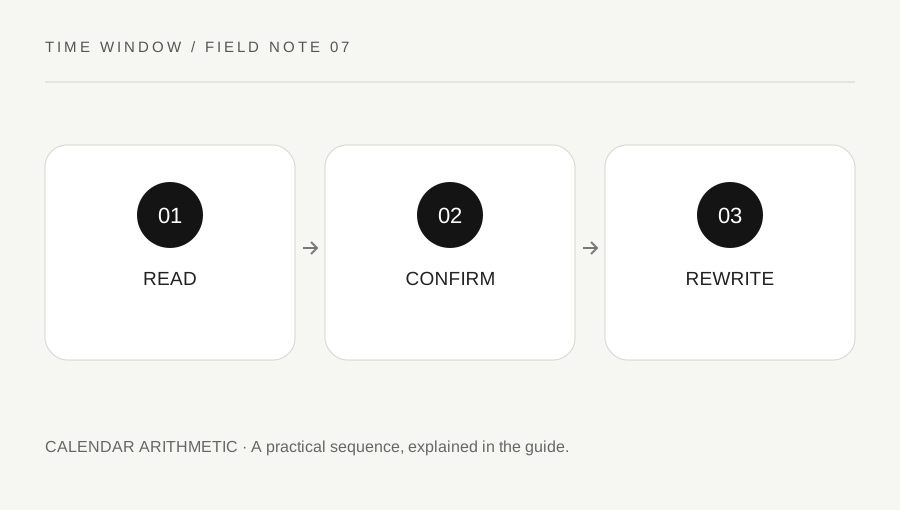
Original explanatory diagram. Numerical examples in this guide illustrate the reasoning; they are not a claim of hands-on testing.
Separate the value from its presentation
The calendar date is the underlying value; the order of its written parts is a presentation choice. In some common conventions, 03/04/2026 represents March fourth. In others it represents April third. Both are valid dates, so a calendar parser may accept either interpretation without detecting a problem.
Look for a stated format, nearby examples or an explicit month name. A document containing 25/04 strongly suggests a day-first convention, but confirm rather than assuming every source in a combined spreadsheet follows it. Data copied from several countries can mix conventions within one column. The appearance of a slash does not supply a universal rule.
Ask for the smallest useful confirmation
When the date matters, ask the sender to write the month in words or confirm the intended order. Include the full year. A short request such as “Do you mean 4 March 2026?” is easier to answer than asking vaguely whether the date is correct. Keep the original entry with the clarification so later users can understand the correction.
Do not resolve ambiguity by selecting whichever interpretation gives a convenient result. A date interval calculator cannot discover the sender's intention. It can only operate on the date you actually enter. A plausible day count is therefore not evidence that the original date was understood correctly.
Use a worked comparison
Suppose an email says a session runs from 03/04/2026 to 06/04/2026. Day-first interpretation gives April third through April sixth. Month-first interpretation gives March fourth through June fourth. Both endpoints can pass ordinary date validation, yet the ranges are completely different.
Before calculating, obtain the intended dates and rewrite them with month names or an agreed year-month-day format. Then choose elapsed or inclusive counting separately. Format ambiguity and endpoint counting are distinct issues: confirming April third does not decide whether to count that starting date. Our date tool exposes the selected date values but cannot resolve an ambiguous source message for you.
Keep imports and displays consistent
When importing a file, inspect the import settings for locale and column type. Test a few known dates, including one with a day greater than twelve and one near a month boundary. Preserve the original text until the conversion has been checked. Changing a cell's display format after a wrong parse does not restore the intended underlying date.
For shared notes, use full month names or an explicitly agreed standard representation. ISO's public introduction explains the purpose of standardized year-month-day notation; use the actual software's input requirements as well. Keep date-only values distinct from timestamps with clock times and offsets. The clearest representation is the one whose meaning and required context are stated at the point of use.
Test a mixed-source column before conversion
Create a small review sample containing an ambiguous date, an unambiguous day-above-twelve example and a year boundary. Compare each parsed value with a confirmed written date. If the source column mixes conventions, split it by source or obtain a normalized replacement instead of applying one global assumption. Keep correction notes at row level when needed. For manual entry, read the chosen month name back before submitting a form. These checks take less effort than rebuilding a schedule after a plausible but wrong parse has propagated through reminders, exports and date differences.
A practical checklist
Tick items for your own use. This checklist is saved only in this browser.
Questions that come up
Does changing a spreadsheet display repair a wrong date?
Not necessarily. A display format changes how an existing value appears. If the original text was parsed as the wrong date, correct the underlying value using the confirmed source interpretation.
Is a date with a day above twelve always clear?
It can help identify an intended order, but mixed sources and invalid entries still occur. Use it as a check, then confirm the convention and the full year for the dataset or message.
What should I write in an international invitation?
Use a full date with the month clearly identified, plus the local time and named zone. A machine-readable calendar invitation is useful, but written context should remain understandable too.
References & scope
Background references checked on 18 October 2026. The examples and practice exercises are original editorial explanations, not copied procedures or professional advice.