ISO Week Numbers Near New Year: Check the Week-Year as Well
A week number needs a week-numbering system and a year. Near New Year, an ISO week can belong to a different week-year from the date’s ordinary calendar year. Keep both labels visible when comparing schedules or exported reports.
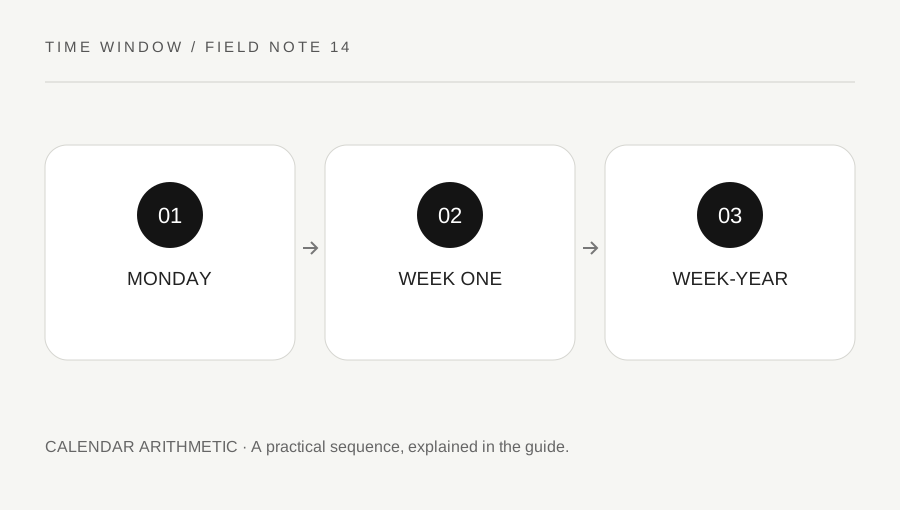
Original explanatory diagram. Numerical examples in this guide illustrate the reasoning; they are not a claim of hands-on testing.
Identify the numbering convention
Not every calendar uses the same definition of week one or the same first weekday. ISO week numbering uses Monday-start weeks and a week-year system. A plain label such as week 1 is incomplete unless the convention and year are understood. Check the application setting or the source's documentation before comparing two numbers.
The ISO system's first week is the one containing the year's first Thursday, equivalently January fourth. This puts a complete seven-day week across some calendar-year boundaries. A date in early January can therefore sit in the last ISO week of the preceding week-year, and a late-December date can sit in week one of the next.
Read the three-part week date
An ISO week-date representation identifies the week-year, week number and weekday. The weekday runs from Monday to Sunday within that system. Do not treat the week-year as merely the first four digits of the ordinary date; it is a separate value returned by a correct ISO-week calculation.
If a spreadsheet or software library supplies these fields, test a known boundary example rather than trusting a function name that only says week number. Some functions offer several conventions. Keep the ordinary full date in the source record too, so a reader can reconstruct the intended day without relying entirely on a week label.
Work through a known boundary
January 1, 2021 was a Friday and belongs to ISO week 53 of week-year 2020. January 4, 2021 was the Monday starting ISO week 1 of 2021. The early-January calendar year and the ISO week-year are therefore different for that first example.
Use this as a validation test for an export or formula. If a report labels January first as 2021 week 53 by combining the calendar year with an ISO week number, it may have built an inconsistent key. Request the actual ISO week-year field or calculate the complete representation using an appropriate verified implementation.
Check sorting and grouping
Group records using the full week-year and week number, not the week number alone. Otherwise week one from several years can merge. Sort using numeric fields or a consistently padded representation. Preserve the full dates when checking totals across a reporting boundary, especially if records arrive in different local zones.
The choice of local date can affect which week an instant belongs to. Convert timestamps to the agreed reporting zone before deriving their local dates and weeks. This is an analytical convention that should be documented separately from the ISO week algorithm. An instant close to midnight may have different calendar dates in different locations.
Use the correct tool for the question
Our site date calculator counts calendar-date intervals and does not return ISO week numbers. Use a calendar application or a verified date library for that specialized representation, and check its documented convention. A date difference divided by seven is a duration in weeks, not an ISO week number.
When sharing a schedule, include the actual date range alongside a week label. A clear note such as a Monday-through-Sunday range makes the label easier to verify. Keep official reporting or organizational week definitions where they differ. Precision comes from stating the system, not from assuming every visible week number means the same thing.
Pad single-digit week numbers consistently when building text labels, but keep the numeric week-year and week fields available for validation. Presentation should not replace the original calendar dates.
A practical checklist
Tick items for your own use. This checklist is saved only in this browser.
Questions that come up
Is day count divided by seven an ISO week number?
No. That gives a duration measured in weeks. ISO week numbering identifies a particular Monday-start week within a defined week-year system.
Can January belong to the preceding week-year?
Yes. For example, January 1, 2021 belongs to ISO week 53 of 2020. The ordinary calendar year and ISO week-year are separate labels near the boundary.
Does this site calculate ISO week numbers?
The current date tool calculates elapsed or inclusive calendar-date counts. Use a verified implementation with a documented ISO-week convention for week-number queries.
References & scope
Background references checked on 18 October 2026. The examples and practice exercises are original editorial explanations, not copied procedures or professional advice.