Compare Timestamps with Different Offsets by Their Instants
Two timestamp strings can show different hours while identifying the same instant. Conversely, identical local clock text can identify different instants when its offsets differ. Normalize the meaning before sorting, comparing or investigating an apparent delay.
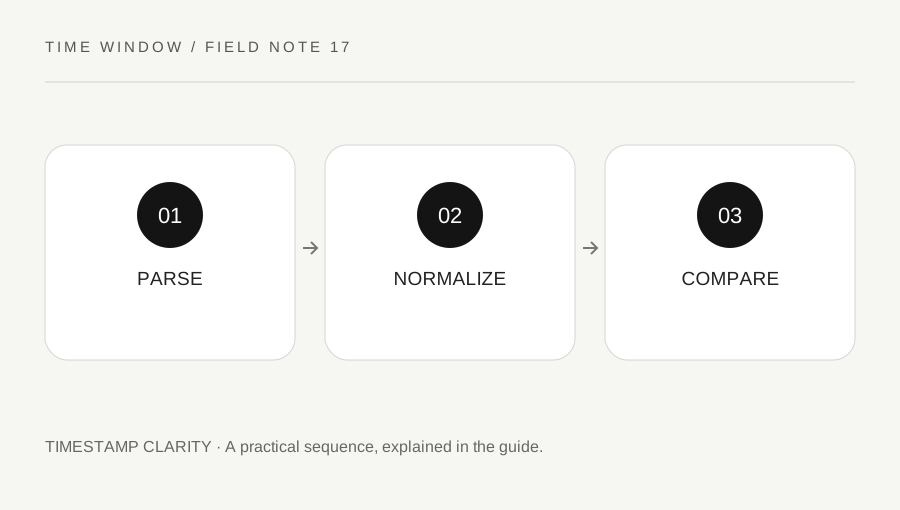
Original explanatory diagram. Numerical examples in this guide illustrate the reasoning; they are not a claim of hands-on testing.
Check the complete timestamp
Read the date, clock time, fractional precision and UTC relationship. A timestamp ending in Z indicates a UTC reference in common standardized notation. A numeric offset states the local reading's difference from UTC for that instant. A bare local reading without zone context may not identify one instant at all.
Do not assume the offset tells you the original location or future seasonal rules. It can disambiguate an individual record while leaving that context unknown. Preserve the original text when parsing so support staff can inspect whether the source supplied an offset, a named zone or an incomplete local value.
Normalize before judging order
For comparison, convert valid records to a common instant representation such as UTC or an appropriately precise numeric timestamp. Compare those values, not only the visible hour. A display at 10:00 with a positive offset can be earlier than a display at 09:00 with a smaller offset.
Do not sort arbitrary mixed-offset strings lexicographically and assume chronological order. A consistently normalized representation may support text sorting under defined conditions, but mixed date formats, offsets or precision can break that assumption. Use a parser and comparison method documented for the actual source format, then test known cases.
Work through equivalent readings
The illustrative readings 2026-01-15T12:00:00Z and 2026-01-15T14:00:00+02:00 identify the same instant. Subtracting the positive two-hour offset from the second local reading yields noon UTC. Their different visible hours do not show a two-hour delay.
By contrast, 12:00 at UTC+02:00 and 12:00 at UTC+01:00 are different instants one hour apart. Preserve the offset when comparing them. If a system strips offsets before storing the text, the remaining strings can become identical while losing the information needed to determine order. That data-loss issue requires fixing the record pipeline, not guessing an offset afterward.
Check precision and clock reliability
Even correctly parsed timestamps have limits. A rounded minute display cannot establish subsecond ordering. Separate devices may have unsynchronized clocks, and logging can occur at different stages of a process. A timestamp difference alone does not necessarily measure network delay or user-perceived duration.
For a support investigation, record what event each field represents, the device or service that generated it and the available precision. Keep the source timezone context and any known clock synchronization information. These details prevent an exact-looking subtraction from being given a stronger interpretation than the records support.
Create a readable comparison note
Show each original timestamp, its normalized UTC representation and the meaning of the recorded event. State any missing context or precision limits. If a bare local time falls in a repeated hour, ask for the offset or another disambiguating record rather than choosing an occurrence silently.
Our converter can display matching UTC references for a supplied local reading and named zone, including both overlap candidates. It is not a batch log parser or a clock-synchronization monitor. Use it for a transparent individual check, then use appropriate data-processing tools for large files with the same explicit parsing and comparison rules.
For a small audit, choose one equivalent pair and one deliberately different pair, then test the comparison method against both. This catches a parser that drops offsets while still producing plausible dates.
A practical checklist
Tick items for your own use. This checklist is saved only in this browser.
Questions that come up
Can different hours represent the same instant?
Yes. Noon UTC and 14:00 at UTC+02:00 describe the same instant in the worked example. Compare normalized instants rather than the local hour alone.
Is string sorting always wrong?
A defined consistently normalized representation can support sorting, but arbitrary mixed formats, offsets and precision should not be assumed safe. Use a documented parser and verify known cases.
Does a timestamp difference prove network delay?
Not by itself. The fields may represent different process stages or come from unsynchronized clocks. Establish event meaning and clock reliability before interpreting the difference.
References & scope
Background references checked on 18 October 2026. The examples and practice exercises are original editorial explanations, not copied procedures or professional advice.