Count Weekdays in a Date Range Without Mistaking Them for Business Days
A Monday-to-Friday count can be calculated from complete weeks and leftover dates. That is a weekday count, not automatically an official business-day count. Holidays, work patterns and endpoint rules need to be specified separately.
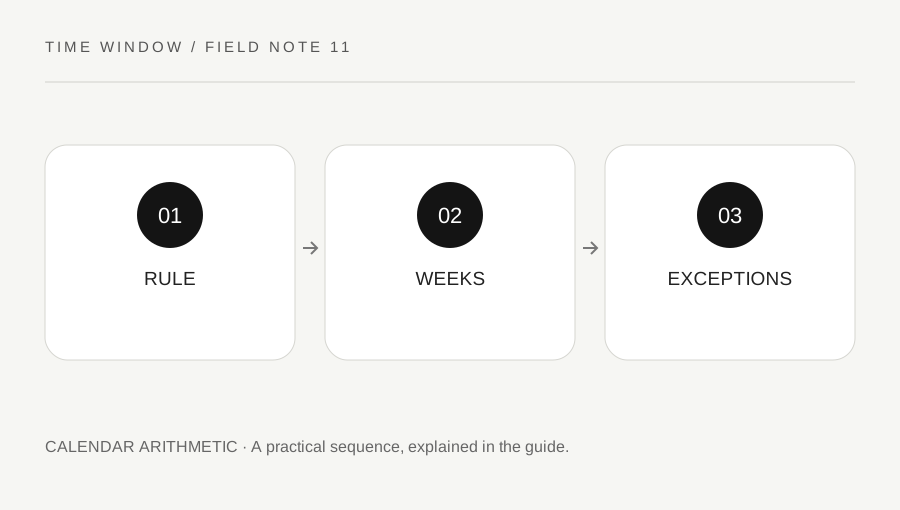
Original explanatory diagram. Numerical examples in this guide illustrate the reasoning; they are not a claim of hands-on testing.
State the range and workweek
Write the confirmed start and end dates and decide whether each endpoint is included. Then define the weekday set. Monday through Friday is common in some settings, but not every organization or jurisdiction uses it. Do not assume a person's work schedule from the country alone.
Our date calculator returns calendar-day differences or inclusive date counts. It does not remove weekends or public holidays. Use it to verify the underlying range, then apply a separate documented weekday method if needed. Keep these stages separate so a difference of one is not hidden inside a holiday adjustment.
Break the range into complete weeks
For an inclusive list of dates with a Monday-to-Friday workweek, each complete seven-day block contains five selected weekdays. Multiply the number of complete blocks by five, then inspect the remaining dates individually. The weekday on which the range starts determines which leftover dates count.
Do not multiply the total day count by five-sevenths and treat the result as exact. A short range containing a weekend behaves differently from one entirely within the workweek. The complete-week method works because each full block contains every weekday once; the remainder still needs an actual calendar check.
Work through a short range
Consider the inclusive range Monday April 6 through Wednesday April 15, 2026. It contains ten calendar dates. The first seven dates contribute five Monday-to-Friday weekdays, and the remaining Monday, Tuesday and Wednesday contribute three more. The weekday count is eight before considering any holidays or organizational closures.
If the start date is excluded, the answer changes. If an organization recognizes a holiday on one of those selected weekdays, the operational count can change again. List each exception and its source instead of silently subtracting an assumed holiday. A public holiday occurring on a weekend can also have a separate observed-date rule, which must be checked under the applicable policy.
Keep official rules outside the shortcut
For shipping, service response windows, contracts or statutory deadlines, use the responsible organization's instructions. They may define a cutoff hour, exclude the receipt date, use a particular local zone or recognize closures beyond public holidays. A correct arithmetic weekday count does not establish the correct legal or operational deadline.
Record the date range, inclusion rule, selected weekdays and each exception beside the result. If the range is long or repeated often, use an appropriate verified calendar or business-day system with maintained holiday data. This manual method is useful for understanding the calculation and checking a small example, while making clear which policy assumptions it cannot supply.
Audit the remainder on a visible calendar
For the leftover dates after complete weeks, write each date and its weekday in a short list. Mark whether it belongs to the chosen workweek before adding any holiday exceptions. This small audit makes off-by-one mistakes easier to see than a single opaque formula. For an inclusive three-date range from Friday through Sunday under a Monday-to-Friday definition, only Friday counts. For Monday through Wednesday, all three count. Both ranges contain three calendar dates, demonstrating why the position of the remainder matters. Keep this list with the calculation when another person needs to review the result.
If two reviewers disagree, compare the marked remainder list first, then the endpoint rule and exception list. This identifies the exact source of the difference instead of debating an unexplained final number.
A practical checklist
Tick items for your own use. This checklist is saved only in this browser.
Questions that come up
Does the site’s date tool count business days?
No. It counts Gregorian calendar dates. A business-day result needs an agreed workweek, holiday jurisdiction, closure policy and sometimes a local cutoff time.
Can I multiply days by five-sevenths?
That gives a proportion, not an exact short-range count. Use complete seven-day blocks and inspect the remaining weekday positions, then apply documented exceptions separately.
Are public holidays the only exceptions?
Not always. Organizations can have additional closures, observed dates or service-specific rules. Use the relevant current policy instead of assuming a generic holiday list is sufficient.
References & scope
Background references checked on 18 October 2026. The examples and practice exercises are original editorial explanations, not copied procedures or professional advice.