Decimal Hours Are Not Clock Minutes: Convert the Fraction Correctly
A decimal fraction of an hour uses a base of one hundred in its written form, while an hour contains sixty minutes. That difference makes 1.50 hours and 1:50 easy to confuse. State the format before adding or comparing durations.
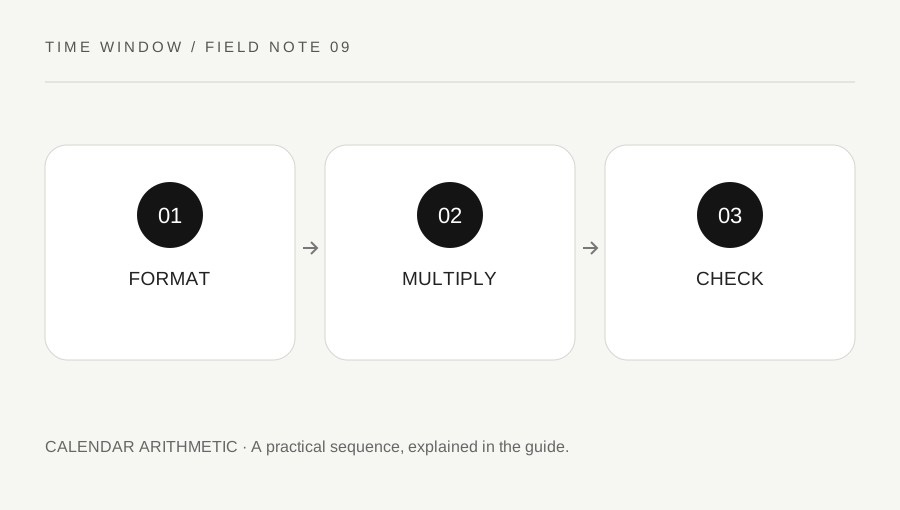
Original explanatory diagram. Numerical examples in this guide illustrate the reasoning; they are not a claim of hands-on testing.
Identify what the separator means
A colon in a duration such as 1:30 commonly separates hours and minutes. A decimal point in 1.30 hours normally means one hour plus thirty hundredths of an hour. Those are different amounts: thirty hundredths multiplied by sixty is eighteen minutes. Never infer the format solely from a number copied without its label.
Ask whether a source records decimal hours, hours and minutes, or a clock time of day. A duration of 25:00 can mean twenty-five hours, while 25:00 is not an ordinary twenty-four-hour clock reading. Keep the quantity type and unit visible in a spreadsheet heading or shared note.
Convert using the fractional part
To convert decimal hours, keep the whole hours and multiply the fractional remainder by sixty. For 2.75 hours, the whole part is two and the fraction is 0.75. The fraction becomes forty-five minutes, giving two hours and forty-five minutes. For the reverse direction, divide minutes by sixty and add the whole hours.
Thus two hours and fifteen minutes equals 2 + 15 ÷ 60 = 2.25 hours. It does not equal 2.15 hours. If seconds are relevant, continue the conversion using the fractional minute. Choose rounding only after deciding the precision the task requires; rounding each intermediate step can accumulate avoidable error.
Check a practical comparison
Imagine two practice sessions recorded as 1.50 hours and 1:50. If the first is genuinely decimal, it lasts ninety minutes. If the second is hours and minutes, it lasts one hundred ten minutes. The apparent difference of forty written digits is not a meaningful way to compare them; converting both to minutes reveals a twenty-minute difference.
For addition, convert each duration to a single unit such as minutes, add, then convert back if desired. Forty-five minutes plus fifty minutes totals ninety-five minutes, or one hour thirty-five minutes. A display reading 0:95 should be normalized rather than interpreted as ninety-five hundredths of an hour.
Keep duration separate from scheduling
Adding a duration to a local clock reading can require more context near midnight or a daylight-saving transition. A two-hour elapsed session needs an actual starting instant if seasonal clock changes occur during it. Decimal conversion alone does not determine the ending local date or time.
Our date tool counts calendar dates and the zone tool converts one local instant; neither is a payroll or timesheet rounding system. Follow the relevant organization's recording and rounding rules separately. Keep original values, units and any chosen rounding method with your calculation. A clear conversion lets you compare quantities accurately without implying that one format decides billing, attendance or official reporting policy.
Check rounding with a small sample
Consider twenty minutes, which is one third of an hour. Written as 0.33 hours, it represents nineteen minutes and forty-eight seconds, not exactly twenty minutes. Repeating that rounded value several times can accumulate a difference. Keep an exact minute count or sufficient precision until the intended final rounding step. For a display meant only for a reader, show both formats, such as twenty minutes and approximately 0.3333 hours. This makes the approximation visible and prevents a rounded display from being mistaken for the exact original duration.
A practical checklist
Tick items for your own use. This checklist is saved only in this browser.
Questions that come up
Does 1.5 hours mean one hour fifty minutes?
No. Half an hour is thirty minutes, so 1.5 hours equals one hour thirty minutes. One hour fifty minutes is 110 minutes, or approximately 1.8333 decimal hours.
Why does my spreadsheet show a different result?
Check whether the cell stores a decimal number, a duration or a time-of-day value. Display formatting can hide the underlying type. Verify a known example before applying a formula to the whole column.
Can this decide timesheet rounding?
No. The arithmetic converts units. An employer or organization can have separate recording and rounding policies, which need to be read and applied independently.
References & scope
Background references checked on 18 October 2026. The examples and practice exercises are original editorial explanations, not copied procedures or professional advice.